Advertorial · Metabolic Review
Why You Wake Up Every Morning With a "Locked Neck" (And Why Your Pillow Is the Last Thing You'd Suspect)
By Dr. Michael Tran | Sleep Biomechanics Researcher | Updated March 2026

I need to tell you something your pillow company doesn't want you to hear.
That stiff, crunchy feeling in your neck every morning? The one where you turn your head and it feels like someone welded your vertebrae together overnight?
It's not because you "slept wrong."
It's not because you're getting older.
And it's definitely not because you need a softer pillow.
It's because of something happening to your cervical spine between 2 AM and 5 AM every single night. Something that most doctors never check for. And something that a $200 memory foam pillow actually makes worse.
Let me explain.
I Spent 11 Years Studying Why People Wake Up in Pain
For over a decade, I worked in a sports rehabilitation clinic. Mostly athletes. Shoulder injuries, knee reconstructions, the usual.But here's what I couldn't figure out:Why were so many of my patients coming in with neck injuries that didn't happen during sports?They'd show up on a Monday morning. Stiff neck. Reduced range of motion. Tingling down the arm. And when I'd ask what happened, the answer was always the same."Nothing. I just woke up like this."A 34-year-old software developer told me his neck felt like it was going to fall off. Said he felt like a bobblehead — his head was too heavy for his body to hold up. A woman in her 50s said her arms felt like they were plugged into a wall socket. Tingling and burning, but nothing visible on the skin.These weren't athletes with impact injuries. These were desk workers, parents, regular people — being slowly wrecked by something they did for 7-8 hours every night.Sleep.Or more specifically... what their pillow was doing to their neck while they slept.

The Problem Has a Name. And You've Probably Never Heard It.
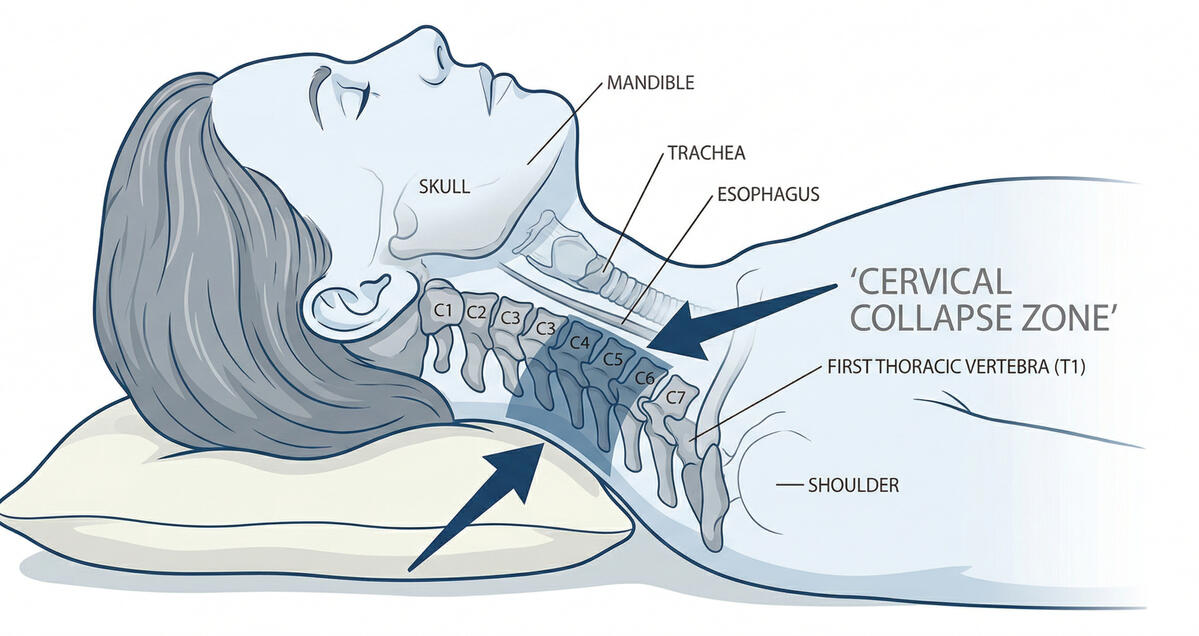
Here's what I found when I started digging into the research:When you lie on a standard pillow — memory foam, down, polyester, doesn't matter — your head sinks. It feels comfortable. Soft. Supportive.But "soft" is the problem.Your head weighs roughly 10-12 pounds. When it sinks into a soft pillow, it drops past the point where your neck is actually supported. Your cervical curve — that natural inward arch in your neck — flattens out completely.Spine specialists call this cervical collapse.But the people who suffer from it every morning have a better name for it.They call it "Locked Neck."That stuck, frozen, can't-turn-your-head feeling? That's your neck muscles seizing up because they spent 6+ hours in a position your spine was never designed to hold.And it gets worse the softer your pillow is.Think about that for a second.The very thing that feels most comfortable when you lay your head down at night... is the thing that's locking your neck up by morning.
Your pillow isn't supporting your neck. It's collapsing it.
And Here's Where It Gets Scary
A locked neck isn't just painful. It's a warning sign.Your cervical spine is the highway for your entire nervous system. When those vertebrae compress — when your neck "bottoms out" on a soft pillow — it doesn't just cause stiffness.It puts direct pressure on your Vagus Nerve.(Pronounced "VAY-gus")You've probably never thought about your Vagus Nerve. But you've felt what happens when it's compressed. That jolt of panic when you wake up at 2 AM with your heart slamming for no reason? That's your Vagus Nerve misfiring.It runs right through your neck. It controls whether your body is in "rest and digest" mode... or "fight or flight."When your neck collapses on a pillow that's too soft, that nerve gets compressed. Your body shifts into stress mode. In the middle of the night. While you're unconscious.That's why you bolt upright at 2 AM with your heart pounding.That's why your brain feels like it's wrapped in fog every morning.That's why you can't remember the last time you woke up actually feeling rested.It's not insomnia. It's not stress. It's not your mattress.It's your cervical spine collapsing onto your Vagus Nerve every single night.And no amount of sleep is going to fix it — because the pillow is causing the problem while you sleep.
➡️ See the pillow that 10,000+ people switched to last month — up to 70% off today
Why Your "Closet Full of Pillows" All Failed
If you've already tried multiple pillows — and you're reading this, so you probably have — I need you to understand something.They didn't fail because they were bad pillows.They failed because they all share the same fatal design flaw.Every standard pillow — even the expensive ones — is built around the same idea: make it soft so it feels good.Memory foam? Soft. It lets your head sink.Down feathers? Soft. They compress under weight.Shredded foam? Soft. It shifts and flattens overnight.They all feel great for the first 30 seconds after you lay down. And then, slowly, over the course of the night, your head drops. Your cervical curve collapses. And by 3 AM, your neck is bottomed out on a surface that's offering zero structural support.This is why one pillow after another ends up in the closet. It's not that you picked the wrong brand. It's that every brand is building on the same broken premise.Softness is the problem. Not the solution.What your neck actually needs isn't comfort. It needs resistance.It needs something that physically prevents your head from sinking past the support zone. Something that holds your cervical curve in its natural arch position — all night — even when you shift positions in your sleep.The sleep research community has a term for this.They call it Therapeutic Resistance.It sounds counterintuitive. A pillow that pushes back? A pillow that doesn't let you sink in?But that resistance is exactly what keeps your neck from collapsing. It's what keeps your Vagus Nerve decompressed. And it's the reason some people are waking up without pain for the first time in years.The question is: what does a pillow built around Therapeutic Resistance actually look like?I spent about three months looking. Tested over a dozen cervical support pillows — the kind you find in physical therapy clinics, orthopedic catalogs, and the "clinical grade" section of Amazon.Most of them had the right idea but the wrong execution. Too expensive. Too bulky. Looked like medical equipment. Or they'd lose their density within a few weeks and you were right back where you started.Then a colleague handed me one that stopped me cold.
The One Feature That Actually Matters
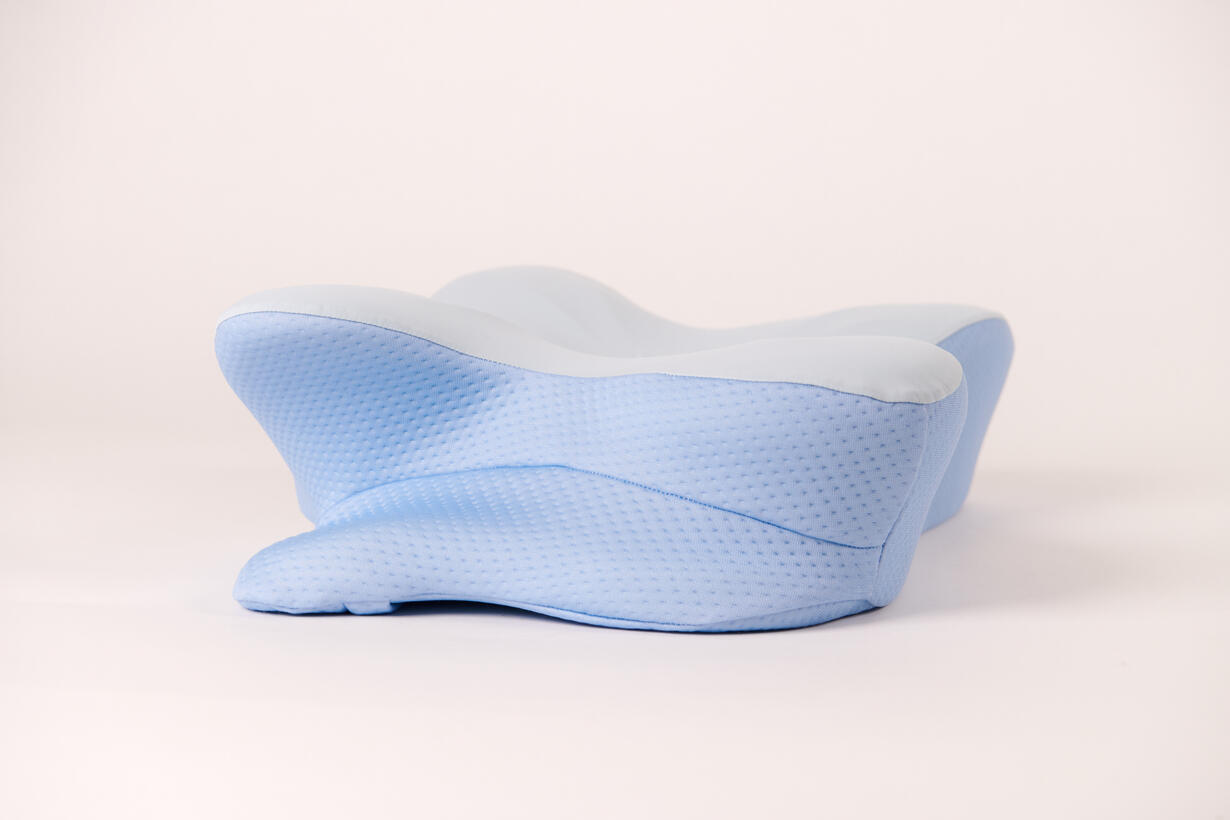
The shape is unusual — a butterfly contour that looks nothing like a regular pillow. I'll be honest, my first reaction was skepticism.But there's one thing about this pillow that separates it from everything else I tested. And it's the only thing you need to understand.There's a raised ridge that runs across the center where your neck rests.That ridge is the entire point.When you lay down on a regular pillow, your neck hovers over empty space. There's nothing underneath the curve of your cervical spine. Your head sinks, your neck follows, and by 2 AM your neck is hanging in dead air while the pillow does nothing.This ridge fills that gap. Physically. It pushes up into your cervical curve and holds it in place — all night — the same way a proper support brace would.Your head can't sink past it. The ridge won't let it.That's it. That's the Cervical Lock.Not a fancy sleep algorithm. Not some proprietary foam blend with a trademarked name. Just a raised ridge in exactly the right place that does what no flat pillow can do — it keeps your neck from collapsing while you sleep.The pillow is called the Derila Ergo. And over 10,000 people switched to it last month alone.
➡️ Try the Derila Ergo Pillow risk-free — 60 night return period + 70% off right now
"But Does It Actually Work?"
That's the right question. And I'm not going to answer it with a dramatic story about someone who nearly died.Instead, here's what I tell my patients:The first night feels strange. The pillow is firmer than what you're used to. Your neck might even feel slightly stiff the next morning — not worse than before, just different.That's the adjustment window. Your muscles have spent years conforming to a collapsed position. They need about 3 nights to "unlearn" that pattern.By night three, something shifts.You stop waking up at 2 AM. Your neck turns freely in the morning. The brain fog starts to clear.It's not magic. It's biomechanics.When your cervical spine holds its natural curve all night, three things happen:One — your neck muscles finally relax instead of seizing up to compensate for a collapsed position.Two — your Vagus Nerve decompresses, shifting your nervous system out of fight-or-flight and into genuine rest.Three — your brain's waste-clearance system can actually do its job. It flushes out the metabolic buildup that causes that heavy, foggy, "I need three coffees" feeling every morning.That's what happens when your neck is properly aligned during sleep. The Derila Ergo is the most affordable pillow I've found that actually achieves it.
Mark, 41, IT Manager — Ohio
"I have a closet full of pillows that all went flat. I'm not exaggerating — like eight of them. My wife ordered this one without asking me. First three nights I almost returned it. Too firm. Felt wrong. By day five my neck wasn't locked up in the morning. Hadn't felt that in years. I stopped thinking about my neck entirely. That's the whole review."
Sarah, 56, Retired Teacher — Arizona
"This is embarrassing but I was scared to drive because I couldn't turn my neck to check blind spots. Two weeks on this pillow and I have full range of motion back. My daughter said I look ten years younger in the morning. I don't know about that but I feel it."
James, 29, Software Developer — Texas
"A buddy told me to try this and I thought he was nuts. A pillow? Really? But I was waking up every morning feeling like I'd been hit by a truck so I figured why not. Brain fog is gone. Neck doesn't hurt. I'm actually sharp in the morning now which never happened before."
Linda, 63, Office Manager — Florida
"Bought two of these for my husband because his snoring had me in the guest room for almost a year. Snoring isn't totally gone but it's maybe 70% better. I moved back into our bedroom last month. He says his neck feels better too. Should have done this a long time ago."
Two Things Nobody Else Will Tell You
I recommend this pillow to my patients. But I'll be straight with you on two points.The first three nights are weird. Your neck has spent years adapting to a collapsed position. When you finally give it proper support, the muscles need time to release. Some people feel stiff for the first two or three mornings. That's the adjustment window. Push through it. By night four, you'll understand why.The ads for this pillow are aggressive. You've probably seen them. They're over the top. I get it. But here's what I tell my skeptical patients: ignore the marketing and look at the biomechanics. A raised cervical ridge that prevents your neck from collapsing isn't a gimmick. Physical therapists have used this exact principle for decades. Derila just made it affordable.
The Math That Makes This Obvious
Let's talk about what bad sleep actually costs you.One visit to a sleep specialist: $200-300.A CPAP machine: $500-1,000.Monthly CPAP supplies: $50-100.Chiropractor visits for neck pain: $70 per session.A "premium" memory foam pillow that goes flat in three months: $150-200.Now multiply that last one by however many are sitting in your closet right now.The Derila Ergo pillow — right now, with the current discount — costs less than a single chiropractor visit.And it comes with a 60-night return period. If it doesn't work, send it back.That's not a risk. That's a test drive.
Here's What I'd Do If I Were You
If you've read this far, you already know something needs to change.The stiff neck isn't normal. The brain fog isn't "just aging." And buying another soft pillow is going to end the same way the last five did.Right now Derila is running a sale — up to 70% off — but it's the kind of discount that disappears once enough people find it. This pillow has sold out twice in the last three months. When it's gone, the price goes back up and you wait.My recommendation: buy one. Give it three nights. Not one — three. Let your neck adjust.If you wake up on day four and nothing has changed, send it back. 60-night return period. You lose nothing.But if you wake up and reach for your coffee before you even remember that your neck used to hurt every morning...You'll know.
➡️ Claim your Derila Ergo Pillow — 60 night return period + up to 70% off
metabolicreview.org
This article is an advertisement. The author has a financial relationship with the products referenced. Results described are individual experiences and not guaranteed. This is not medical advice. Consult your physician regarding sleep disorders or chronic pain. See retailer site for full terms, return policy, and pricing details.